Options for Heart Valve Repair
Quick Facts
- Early treatment for heart valve disease may help prevent complications.
- Heart valve repair is preferred over replacement when possible.
- Minimally invasive repair options are available for some people.
It’s important to track possible heart valve disease symptoms and get regular checkups, especially as you get older, so valve problems can be found and treated early. Early diagnosis and treatment may help prevent complications.
Medications may help your heart pump blood more effectively and manage symptoms. However, a diseased heart valve is a mechanical problem that cannot be fixed with medication alone. Surgery or another procedure may be needed to repair or replace the damaged valve.
Without treatment, valve disease may can affect heart function and may limit future treatment options. Talk with your healthcare professional about any symptoms you may have.
Repair or replace a heart valve?
When possible, it’s generally best to repair a heart valve and preserve your own valve tissue. However, if the valve is too damaged, a replacement valve may be needed. Replacement valves can come from a human donor, animal tissue or a mechanical valve.
Several procedures can repair a damaged heart valve. The procedure used can depend on the valve involved and the type of valve disease. Common heart valve repair procedures include:
- Balloon valvuloplasty
- Transcatheter edge-to-edge repair (TEER)
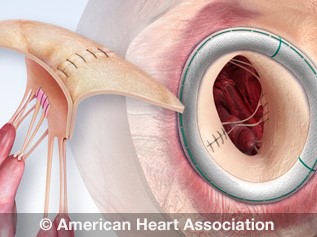
- Mitral valve annuloplasty to repair a leaking valve
Balloon valvuloplasty
View an animation of valvuloplasty.
Balloon valvuloplasty can improve blood flow and may help delay valve replacement. However, it is not a replacement for heart valve surgery. The procedure is performed during a cardiac catheterization, making it less invasive than open-heart surgery.
During a balloon valvuloplasty, a thin catheter with a balloon on the tip is guided to the narrowed heart valve. The balloon is then inflated to widen the valve opening and help improve blood flow.
Treatment outcomes can vary depending on the complexity of the valve problem and the experience of the medical team performing the procedure. If you have a complex valve condition, it is important to seek care from a team experienced in diagnosing and treating heart valve disease.
Transcatheter edge-to-edge repair (TEER) for mitral regurgitation
TEER is a minimally invasive procedure. There is no need for open-heart surgery.
During TEER, doctors use a catheter that is guided to your heart through a vein in your leg to reach the mitral valve. A small clip is attached to your mitral valve to help it close more completely. This can help restore normal blood flow through the heart.
TEER may help reduce symptoms and improve the quality of life for some people with severe mitral regurgitation who cannot have surgery. Your healthcare team can help determine whether TEER is right for you.
TEER is available for qualifying patients covered by Medicare and Medicaid. Learn more about coverage for TEER through the Centers for Medicare & Medicaid Services(link opens in new window).
Print our pre-surgery checklist: Facing and Recovering from Major Surgery (PDF) | Spanish (PDF)