Types of Aneurysms
Quick Facts
- There are three types of aneurysms: abdominal aortic, thoracic aortic and cerebral aneurysms.
- Some people with aneurysms do not have symptoms.
- A ruptured aneurysm is a life-threatening emergency. Call 911 and seek medical attention right away if you or someone else has symptoms.
Abdominal aortic aneurysm
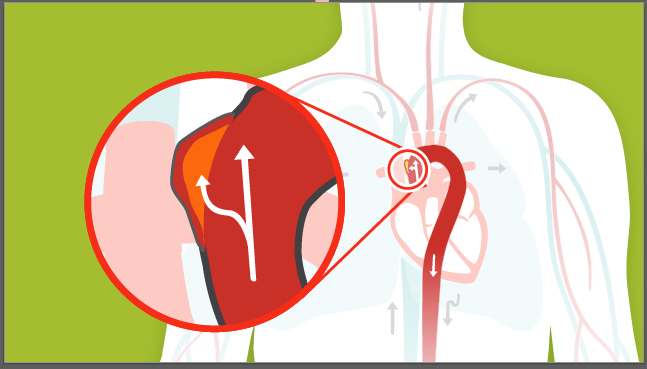
An abdominal aortic aneurysm occurs when the large blood vessel (the aorta) that supplies blood to the abdomen, pelvis and legs becomes weakened, enlarged or balloons outward. This type of aneurysm occurs most often in older men with one or more risk factors, such as emphysema, family history, high blood pressure, high cholesterol, smoking and obesity.
Women are less likely to develop an abdominal aortic aneurysm than men. But when they do, they often have a rupture at smaller aneurysm sizes and have worse outcomes.
The rupture of an abdominal aortic aneurysm is a life-threatening medical emergency. Call 911 and seek medical attention right away if you or someone else has extreme belly or back pain that doesn't go away. Learn more about this type of aneurysm.
Cerebral aneurysm
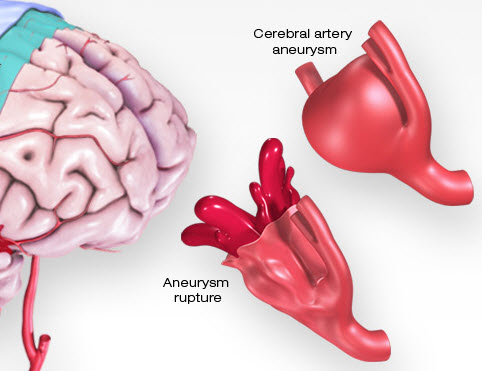
Cerebral aneurysms, which affect about 3% to 5% of people in the U.S., occur when the wall of a blood vessel in the brain weakens and bulges or balloons out. The two main structural types of cerebral aneurysms are berry (saccular) and fusiform. A third, less common category is mycotic aneurysms, caused by infection of the arterial wall.
The berry aneurysm is the most common and occurs more often in adults. It can range in size from a few millimeters to more than two centimeters. A family history of aneurysms may increase your risk.
Conditions that injure or weaken the walls of the blood vessel, including atherosclerosis, trauma or infection, may also cause cerebral aneurysms. Other risk factors include polycystic kidney disease, narrowing of the aorta and endocarditis.
As with other types of aneurysms, cerebral aneurysms may not have any symptoms. But symptoms may include:
- Severe headache (“worst headache of life”)
- Pain above or behind the eye
- Nausea or vomiting
- Stiff neck
- Loss of consciousness (brief or prolonged)
- Sensitivity to light
- Numbness
- Weakness
- Facial paralysis on one side
- Dilated pupil
- Vision changes or double vision
- Seizures
A ruptured cerebral aneurysm is a life-threatening emergency. Call 911 and seek medical attention right away if you or someone else has symptoms. Learn more about cerebral aneurysms.
Thoracic aortic aneurysm
A thoracic aortic aneurysm is an abnormal bulging or ballooning of the part of the aorta that passes through the chest down to the diaphragm. A common cause is atherosclerosis, or hardening of the arteries. It can also come from genetic conditions or injuries affecting the aortic wall.
Other risk factors include:
- Male sex
- Chronic obstructive pulmonary disease
- Aging
- Hypertension (high blood pressure)
- Smoking
- Previous aortic dissection
- Genetic conditions, such as Marfan syndrome and Ehlers-Danlos syndrome
- Inflammation of the aorta
- Injury from chest wall trauma
- Infections, including staph, salmonella and syphilis
A person with an aneurysm may not have any symptoms until the aneurysm expands, compresses nearby structures or begins to leak.
Symptoms of a thoracic aortic aneurysm may include:
- Hoarseness
- Difficulty swallowing
- High-pitched breathing (stridor)
- Swelling in the neck or face
- Chest or upper back pain
- Clammy skin
- Nausea and vomiting
- Rapid heart rate
- A sudden sense of impending doom
A ruptured thoracic aortic aneurysm is a life-threatening emergency. Call 911 and seek medical attention right away if you or someone else has symptoms. Learn more about this type of aneurysm.


